
Which Nike Classic Fits Your Feet and Style Better?
AF1s are roomier and more substantial; AJ1s fit slimmer with heritage color blocking. See sizing starting points by foot shape, cut and materials.
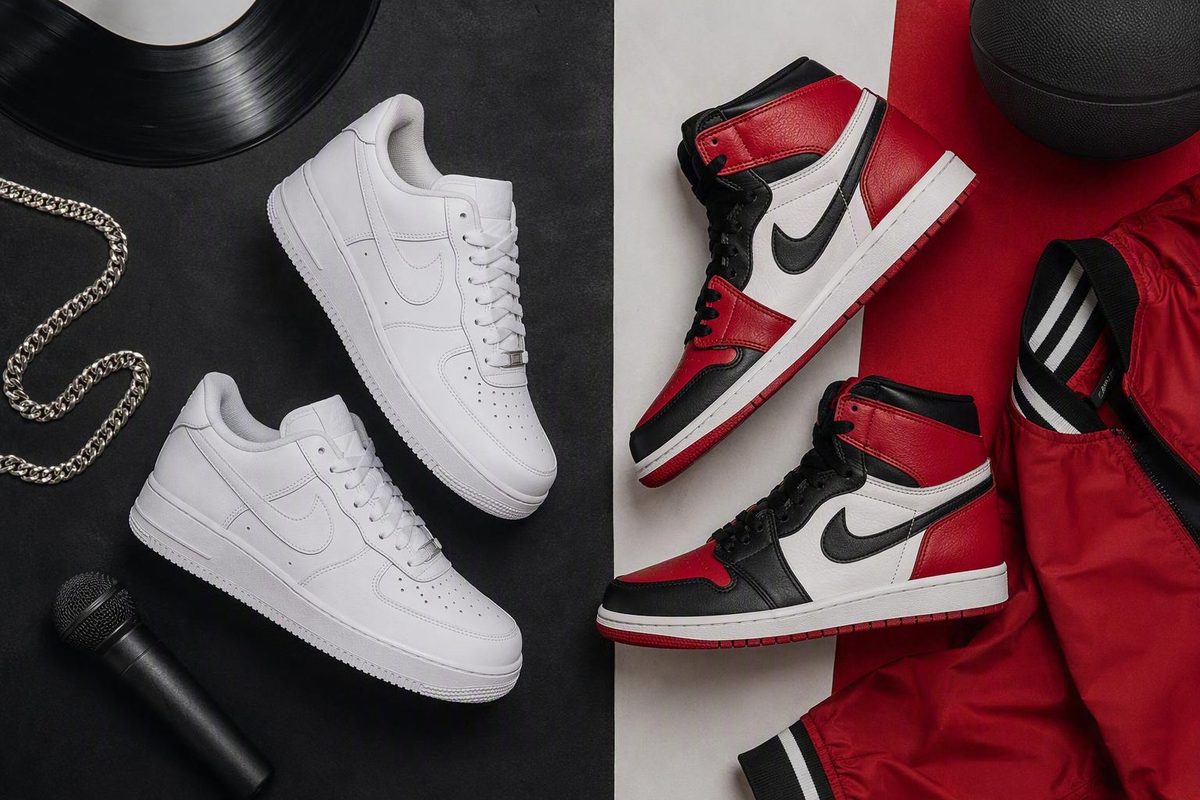
Choose the Air Force 1 if you want more interior room, a substantial silhouette, and neutral everyday styling. Choose the Air Jordan 1 if you prefer a slimmer fit, heritage color blocking, and a stronger connection to Michael Jordan and sneaker collecting.
Neither shoe is the universal winner. Fit varies by foot shape, preferred snugness, cut, padding, materials, production year, and exact release. Treat the recommendations below as starting points rather than guarantees.
The short answer: which shoe should you choose?
| Comparison | Air Force 1 | Air Jordan 1 | Best starting point |
|---|---|---|---|
| Debut and original purpose | Basketball shoe released in 1982 | Basketball shoe introduced in 1985 | Both began as basketball designs, according to a third-party sneaker marketplace comparison |
| General silhouette | Rounder, taller, wider, and more substantial | Slimmer, narrower, and closer to the foot | AF1 for visual bulk; AJ1 for a streamlined profile |
| Reported fit | Roomier, especially through the forefoot and upper | More fitted and potentially snug through the width | AF1 for space; AJ1 for a closer hold |
| Styling character | Simple, neutral, and easy to repeat | More assertive paneling and color blocking | AF1 for understated outfits; AJ1 as a focal point |
| Cultural association | Streetwear and hip-hop | Michael Jordan, basketball heritage, and collecting | Choose the history that matters more to you |
| Present-day role | Neutral lifestyle styling | Heritage styling and collector-led outfits | Use current performance footwear for regular competitive basketball |
Start with the Air Force 1, particularly the Low, if you prioritize forefoot room, upper volume, a thicker-looking platform, or a sneaker that can sit quietly in a daily rotation. Tonal white and black versions are the clearest examples of its understated appeal.
Start with the Air Jordan 1 if you want a narrower, more shaped silhouette. Its layered panels and contrasting heritage colorways make it more visually assertive, while its connection to Michael Jordan gives it a distinct basketball and collecting context.
These are model-family tendencies reported by commercial sneaker editorials, retailer comparisons, and personal sizing guides. They are not standardized measurements, manufacturer-confirmed fit rules, or evidence that either model is universally better for comfort, durability, cushioning, or value.
Fit and sizing: the difference that matters most
Air Force 1 and Air Jordan 1 can both be described as true to size while feeling noticeably different. For this comparison, “true to size” means that your established Nike lifestyle-sneaker size is a reasonable starting point. It does not mean the shoes have identical width, upper volume, padding, toe shape, or heel hold.
A personal, affiliate-supported sizing guide describes the AF1 as roomier and the AJ1 as narrower. A commercial sneaker marketplace makes similar observations, but neither source provides standardized internal measurements. Use this matrix to decide which sizes to compare:
| Foot profile and preference | Air Force 1 starting point | Air Jordan 1 starting point | Trade-off |
|---|---|---|---|
| Narrow or average foot seeking a snug fit | Compare your established Nike size with half a size down | Begin with your established Nike size | A smaller AF1 may improve heel hold but create toe or forefoot pressure, according to this personal sizing guide |
| Wide foot | Begin with your established Nike size | Compare your established Nike size with half a size up | A larger AJ1 may relieve width pressure but add length, heel movement, and creasing, as outlined in this commercial sneaker comparison |
Do not automatically reduce your Air Force 1 size because other buyers do. The smaller option may feel more secure around the heel, but reject it if your toes approach the front or the upper compresses the sides of your forefoot. Wide-footed buyers should generally test their established size first.
For an Air Jordan 1, begin with your established Nike lifestyle-sneaker size. If the forefoot feels compressed, compare the next adjacent size rather than assuming the upper will eventually solve the problem.
When trying either model, evaluate four areas:
- Toe room: Your toes should not press against the front while standing or walking.
- Forefoot pressure: The sides of the shoe should not pinch or force your toes together.
- Heel movement: Persistent lifting may indicate too much length or interior volume.
- Top-of-foot volume: Check for concentrated pressure beneath the tongue, eyestay, and laces.
Wear the socks you expect to use with the shoes.
Materials and construction also matter.
Shape and on-foot feel: substantial versus streamlined
The Air Force 1 generally looks larger because its proportions are more substantial. Third-party comparisons describe a rounder toe box, taller and wider upper, and thicker platform. Even when its length is appropriate, that combination can create a spacious feel and a visually heavier stance.
The Air Jordan 1 has a more shaped profile. Its toe and midfoot appear slimmer, while the upper tends to sit closer to the foot. That can feel secure on some narrow or average feet but restrictive for a wearer who needs more forefoot width or top-of-foot volume.
Retailer and personal sizing comparisons also characterize the AF1 as bulkier and heavier and the AJ1 as slimmer, lighter, and closer to the ground. Those descriptions are perceived differences, not fixed specifications based on matched sizes, materials, or cuts.
Comfort therefore depends on what your foot and wardrobe need. The AF1 emphasizes space and the feel of a substantial platform. The AJ1 emphasizes a closer, lower-profile hold. A wearer who dislikes excess volume may prefer the Jordan, while someone who feels compressed in narrow sneakers may favor the Air Force 1.
One personal sizing guide reports that some Air Jordan 1 releases become more comfortable as their uppers soften. That does not establish a universal break-in period, and it does not mean a shoe causing clear width or toe pressure will eventually fit correctly.
Low, Mid, and High: what changes and what does not
Both model families appear in multiple cuts, so “Air Force 1” or “Air Jordan 1” is not a complete fit specification. Low, Mid, and High versions can differ in ankle coverage, collar structure, padding, heel feel, and perceived interior space.
One personal sizing guide portrays Air Jordan 1 Low, Mid, and High releases as broadly similar in basic length and width. That observation comes from individual experience rather than standardized measurements, so it should not be treated as proof that every cut or release has identical dimensions.
Do not change size solely because you are moving from a Low to a Mid or High. Begin with the size that has worked in the same model family, then assess the exact pair. A heavily padded collar can make the heel feel more contained, while a thinner or softer upper may create more perceived space.
Construction can matter as much as cut. Smooth leather, suede, premium uppers, reinforced panels, and extra tongue or collar padding can all affect pressure and hold. An Air Jordan 1 Low with additional padding should not be assumed to fit like every other AJ1 Low, and the fit of one Air Force 1 edition should not be generalized to the entire family.
When buying remotely, your strongest reference is a known size in the same model and cut. A previous AJ1 High is more useful for estimating another AJ1 High than a broad claim about how all Jordan 1s fit.
From basketball shoes to two different cultural identities
Nike dates the Air Force 1’s release to late October 1982, identifies Bruce Kilgore as its designer, and says the shoe began crossing into lifestyle wear in 1985 through limited retail programs. Those details come from Nike’s own Air Force 1 history, so promotional quality and popularity claims should be distinguished from the documented launch timeline.
The AF1 later became especially associated with streetwear and hip-hop. Its straightforward paneling and tonal colorways allow it to function as an everyday uniform rather than only as a statement release. White on White and Black on Black are representative examples: the simple treatments emphasize the silhouette instead of a complicated color story.
A retailer comparison dates the Air Jordan 1 to 1985 and connects it directly to Michael Jordan and his early Chicago Bulls career. That history helps explain why the model remains closely associated with basketball heritage, named releases, and sneaker collecting. This is a third-party retailer account, not a first-party Jordan archive.
Chicago, Bred, Royal, and Shadow illustrate the AJ1’s different styling language. Their contrasting panels make the shoe’s construction more visible, allowing a colorway to carry historical or collector meaning even when the pair is worn casually.
Neither identity is inherently more important. The AF1 has particularly strong associations with continuity in street style and hip-hop, while the AJ1’s appeal is more directly tied to Michael Jordan, basketball history, recognizable colorways, and release culture.
Everyday style, walking, and basketball use
For understated everyday outfits, the Air Force 1 Low is the more neutral editorial choice. Its simple upper and substantial sole can work with jeans, sweats, cargos, shorts, and relaxed tailoring. Tonal versions are especially useful when the sneaker should support an outfit rather than dominate it.
The Air Jordan 1 is the more visually assertive option. Its layered construction and heritage color blocking can become the focal point of an outfit. It is the stronger starting point when the colorway’s story, Michael Jordan connection, or collector context matters as much as versatility.
Neither shoe can be declared universally better for all-day walking. The AF1’s extra room may suit one wearer, while another may dislike its perceived bulk. The AJ1’s closer fit may feel controlled to some people and restrictive to others. No supplied source offers matched long-wear or fatigue testing that would establish an overall winner.
Although both models began as basketball shoes, neither retro silhouette should be the default recommendation for frequent modern competitive play. Current basketball footwear uses newer cushioning and lateral-support systems designed for contemporary on-court demands, according to a retailer comparison of the two models.
Before choosing, ask:
- Do you want a spacious upper or a closer wrap?
- Do you prefer a thick, substantial profile or a slimmer shape?
- Should the sneaker blend into an outfit or become its focal point?
- Are you more interested in hip-hop and streetwear continuity or Michael Jordan and collector history?
- Can you compare your established size with the relevant adjacent size?
- Are you evaluating the exact cut, materials, and construction you intend to buy?
Care depends on the material, not just the model name
Clean the upper in front of you rather than applying one routine based only on the model name.
For smooth leather:
- Remove the laces.
- Brush away loose surface dirt with a soft brush.
- Spot-clean gently with mild soap and water.
- Remove remaining cleaner without soaking the shoe.
- Let the pair air-dry away from direct sunlight or heat.
For suede, use a material-specific brush and cleaner instead of treating it like smooth leather or saturating it with water. Mixed-material and special-edition pairs may need separate treatment for each panel.
No cleaning routine guarantees complete stain removal or restoration. Test any product on an inconspicuous area first, particularly when a release uses dyed suede, contrasting panels, or an uncommon finish.
Frequently asked questions
If I wear the same tagged size in both, will they feel the same?
Probably not. The same tagged length may work in both, but the AF1 is generally reported as wider and higher-volume, while the AJ1 tends to feel narrower and closer to the foot. Compare forefoot pressure, top-of-foot space, and heel hold rather than relying only on the label.
Which is usually the better starting point for wide feet?
The Air Force 1 is generally the more forgiving starting point because third-party guides describe it as roomier. Begin with your established Nike lifestyle-sneaker size. With the Air Jordan 1, test that baseline first and compare the next adjacent size only if width pressure remains, checking carefully for added length and heel movement.
Can either shoe still be used for modern competitive basketball?
A playable pair can physically be worn on a court, but neither retro model is the best default for frequent modern competition. As explained in the cited use section above, current performance basketball footwear offers newer cushioning and lateral-support systems. Keep the AF1 and AJ1 primarily as lifestyle choices unless you have deliberately assessed the exact pair for your playing needs.
The final choice is conditional: start with the Air Force 1 for more room, a substantial silhouette, and low-key versatility; start with the Air Jordan 1 for a slimmer fit, heritage color blocking, and Michael Jordan collecting context. Before buying, try the exact release and check width, volume, toe room, and heel movement—especially before making any half-size adjustment.