
Choose Your Max Cushion Trainer By Width And Ride
Compare More v6, Bondi 9 and Vomero 18 cushioning, drop and width options, with a fit-first selector to help choose which daily trainer to try first.
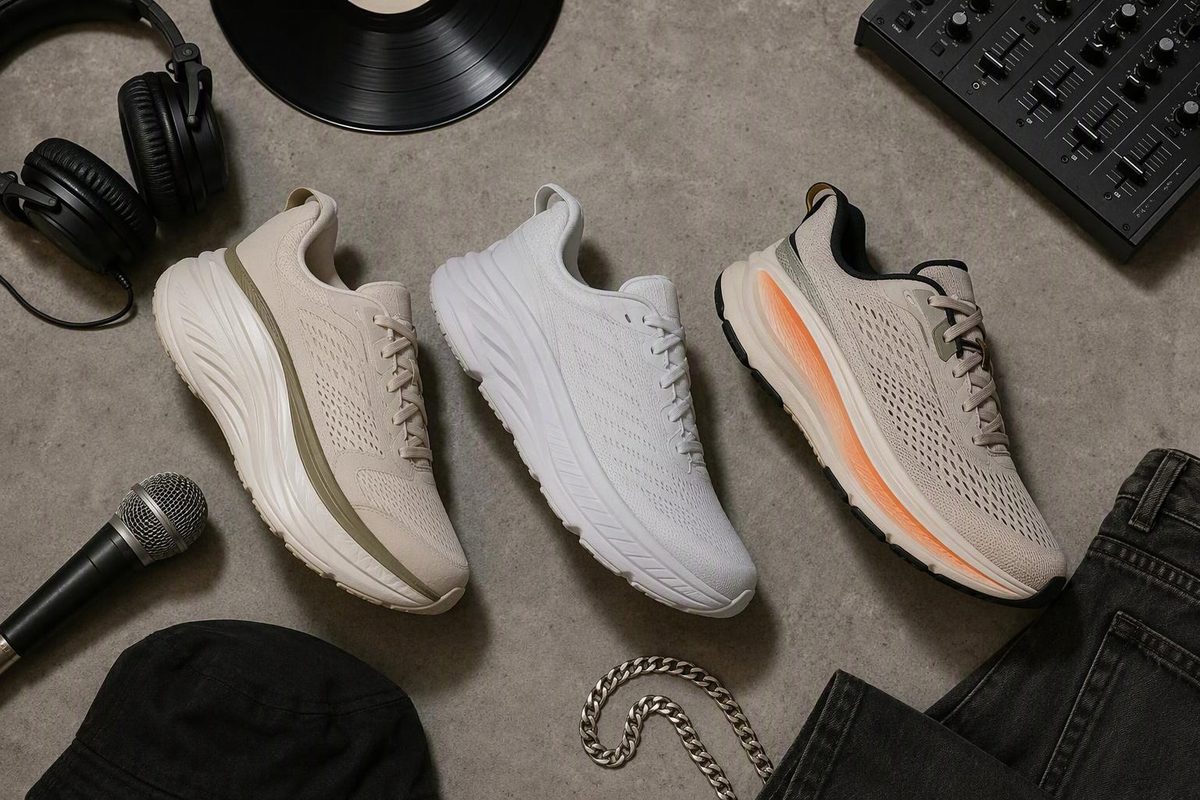
The New Balance Fresh Foam X More v6, HOKA Bondi 9 and Nike Vomero 18 are useful max cushion daily trainers to shortlist, but there is no source-backed overall winner here. Start with the More v6 if multiple width options matter, the Bondi 9 if you want to test a rocker-shaped ride, or the Vomero 18 if you want Nike’s ZoomX-over-ReactX construction with a dedicated wide option. Choose the shoe that holds your heel and midfoot without crowding your forefoot—not the one with the thickest-looking sole.
Choose your priority and fit concern; the selector gives you a model to try first and a specific check to make.
Find Your First Try-On
New Balance More v6
The cited US men’s listing offers D, 2E and 4E widths. Compare widths before adding length if length already feels right.
Check forefoot pressure without accepting a loose heel. Width labels do not establish your size.
A starting point, not an overall winner or size prescription.
| Model | Drop | Try It For |
|---|---|---|
| More v6 | ~4 mm | D, 2E and 4E width choices |
| Bondi 9 | 5 mm | Meta-Rocker ride |
| Vomero 18 | 10 mm | ZoomX above ReactX; wide version |
More v6: Evidence And Caveat
New Balance lists Fresh Foam X and a gusseted tongue intended to help secure fit. RTINGS describes a softer forefoot and more accommodating feel than Bondi 9; that does not establish your size. Width availability varies by size and color.
Bondi 9: Evidence And Caveat
Fleet Feet lists supercritical EVA and Meta-Rocker geometry. Its reviewers disagreed about softness and sizing; one reported wider-midfoot pinching. Do not apply a reviewer’s half-size-down choice to everyone.
Vomero 18: Evidence And Caveat
Nike lists 46 mm heel and 36 mm forefoot stack. Its wide version adds ~6.35 mm of toe-box girth, not flat internal width. These details do not apply to the retro-styled Vomero 5.
Sources: New Balance US men’s More v6 listing; RTINGS More v6 review; Fleet Feet men’s Bondi 9 listing and review; Nike US men’s Vomero 18 Wide listing. Listings checked October 6, 2026. Specifications are not our measurements.
These are source-led shopping starting points, not an on-foot ranking by Str8 Hip Hop. Manufacturer specifications describe construction and available versions; reviewer impressions help identify what to test. Neither establishes which shoe will feel best on your foot. The distinction matters most with the Bondi 9, whose reviewers reported different experiences of both cushioning and fit.
Cushioning, Drop And Fit Answer Different Questions
“Max cushion” is a shopping category, not a guarantee that a shoe will feel softest or fit best. Keep sole thickness, heel-to-toe drop and upper fit separate when comparing these models.
Stack height describes the thickness of the sole beneath your foot, usually specified separately at the heel and forefoot. Nike lists both measurements for the Vomero 18. The cited material used here does not provide a comparable pair of stack figures for every model, so this shortlist cannot establish a three-way stack-height ranking.
Heel-to-toe drop is the difference between heel and forefoot height, not the amount of cushioning under the entire foot. A lower drop figure does not, by itself, establish a softer shoe. Likewise, the Vomero 18’s higher listed drop does not tell you whether its forefoot will feel more comfortable than the More v6’s.
Fit concerns the space inside the upper and how securely it holds your foot. A broad-looking sole does not establish that the upper will accommodate your midfoot. Width availability is useful, but the label still needs an on-foot check: enough room across the front does not excuse a loose heel or pressure over the top of your foot.
The Three Models Have Different Buying Priorities
The specifications below refer to the cited US men’s listings. Drop figures are manufacturer or retailer specifications, not our measurements. Listed widths do not guarantee stock in your size and color, and these listings do not establish the options available in women’s models or other markets.
| Model | Cushioning | Listed Drop | First Check |
|---|---|---|---|
| More v6 | Fresh Foam X | Approximately 4 mm | D, 2E or 4E fit |
| Bondi 9 | Supercritical EVA; Meta-Rocker | 5 mm | Rocker and midfoot |
| Vomero 18 | ZoomX above ReactX | 10 mm | Regular versus wide |
The table is a starting order for trying shoes, not a performance podium. For example, someone seeking more forefoot room has a concrete reason to investigate the More v6’s width range. That does not establish that its standard width will fit better than another model’s wide version.
There is also no comparable price set in the supplied research. This comparison therefore does not name a value winner or treat one model as worth a particular premium. It focuses on the construction, fit choices and review findings that the cited sources actually support.
More v6 Offers The Clearest Width-Based Starting Point
New Balance positions the Fresh Foam X More v6 for everyday running, walking and all-day wear. Its cited men’s listing offers standard D, wide 2E and extra-wide 4E. The shoe also has a gusseted tongue intended to help secure the fit. Those are reasons to put it first on your try-on list if ordinary running-shoe uppers repeatedly squeeze your forefoot. See the New Balance More v6 product details.
The width choices are the strongest concrete distinction here. They let you compare width at a suitable length rather than immediately moving to a longer size. A 4E listing is an option to investigate, not evidence that everyone with a wide foot needs it. The research does not provide internal dimensions that would let you convert these labels into an exact amount of usable space.
RTINGS’ tested comparison describes the More v6 as having a softer forefoot and a more accommodating feel than the Bondi 9. That supports trying the More v6 when forefoot plushness and accommodation are priorities. It does not establish your size or prove that every foot will find it more comfortable. The comparison is specifically between these models, not a finding that the More v6 is the softest daily trainer available. See the RTINGS More v6 review and comparison.
During a try-on, separate the width decision from the cushioning decision. First check whether your toes and forefoot have room without your heel moving around. Then assess how the cushioning feels. If the foam feels appealing but the upper still presses against your foot, the width or model remains unresolved; the cushioning has not made the fit acceptable.
Bondi 9 Needs A Ride Test And A Midfoot Check
The Bondi 9 combines supercritical EVA with HOKA’s Meta-Rocker geometry and has a listed 5 mm drop in the cited Fleet Feet men’s product listing. Its rolling sensation is a reason to try it, rather than a reason to assume it will suit you.
Fleet Feet’s testers did not agree on the ride. Some found it balanced; others considered it excessively soft, and some preferred it for walking rather than running. That disagreement is useful shopping evidence: the same construction produced different impressions. It does not support presenting the Bondi 9 as uniformly soft, uniformly stable-feeling or universally better for one activity.
Their sizing experiences also differed. Some testers chose half a size down, while another reported pinching where his wider midfoot met the upper and midsole. Do not turn a reviewer’s half-size-down choice into a blanket sizing recommendation. These are individual experiences in the Fleet Feet Bondi 9 review, not a manufacturer rule for all buyers.
For this model, check the rolling sensation and upper pressure independently. You might like the way the shoe moves through a step while disliking how it holds your midfoot. Conversely, an acceptable upper fit does not establish that you will enjoy the rocker. A brief fit decision based only on standing still leaves the distinctive ride untested.
If walking and running are both part of your intended use, assess both before deciding. The reviewers’ differing preferences justify that comparison, but they do not predict your result. The practical verdict is to keep the Bondi 9 on the shortlist when its ride interests you, while refusing to overlook midfoot pinching simply because its sole looks generous.
Vomero 18 Requires An Exact Version Check
Nike’s Vomero 18 uses ZoomX above ReactX. Nike lists a 46 mm heel stack and a 36 mm forefoot stack, with a 10 mm drop. These figures describe the cited model; they are not measurements taken by Str8 Hip Hop.
The dedicated wide version adds approximately 6.35 mm of toe-box girth, according to Nike. Girth is not flat internal width, so do not read that number as an extra 6.35 mm of side-to-side space beneath your toes. It also does not establish an equivalent New Balance width label. The construction, stack figures and wide-version claim come from Nike’s Vomero 18 Wide specifications.
That distinction makes the exact product version part of the buying decision. If you are considering the Vomero 18 because of forefoot pressure, check whether the listing is for the regular or wide shoe rather than relying on the model name alone. Compare the versions at an appropriate length and assess the heel and midfoot as well as the toe box. Additional space at the front is useful only if the rest of the fit works for you.
The supplied research does not establish that the two-foam construction makes the Vomero 18 softer than both alternatives. Nor does its listed stack establish a complete height ranking, because comparable heel and forefoot figures are missing here for the other two shoes. Treat the foam names and dimensions as specifications, not a substitute for an on-foot comparison.
Do not confuse the Vomero 18 with the retro-styled Vomero 5. Nike describes the latter as a running-inspired sportswear sneaker—a different shopping proposition from the Vomero 18’s maximum-cushion road-running design. The shared family name is not enough to treat them as alternatives with the same intended role. See Nike’s Vomero 5 overview.
Let Forefoot Room And Heel Hold Settle The Choice
Try both the left and right shoe using the socks you intend to wear. Check toe room, forefoot pressure, top-of-foot pressure and heel movement separately. A single impression of “comfortable” can conceal a trade-off: generous space at the front may coexist with unwanted movement at the back.
Nike’s fit guidance calls for comfortable toe wiggle room with a snug midfoot and heel, rather than a foot that slides around inside the shoe. That gives you a more useful fit target than choosing by cushioning alone. See the Nike sneaker fit guide.
If the length is right but the forefoot is cramped, compare widths before automatically adding length. The More v6’s D, 2E and 4E options make that comparison explicit; the Vomero 18 offers a dedicated wide version. Our EE and 2E width guide explains why the label is only a starting point, not a guaranteed fit across different models.
If your heel lifts, do not assume that more forefoot space is the solution. Reassess the fit of the version you are wearing. Similarly, midfoot pinching deserves its own decision rather than being folded into a general complaint that the shoe feels small. The Bondi review illustrates why: a tester’s pressure point and another tester’s preferred length adjustment were not the same finding.
When two shoes both fit acceptably, compare the specific ride difference that brought them onto your shortlist. That might be the More v6’s reviewer-described forefoot softness, the Bondi 9’s rolling sensation or the Vomero 18’s two-foam construction. There is no need to force those features into an unsupported universal ranking.
The purchase decision is settled when the chosen width and length work together, the heel and midfoot stay comfortably held, and the ride suits the use you tested. If cushioning feels good but the upper still squeezes or slips, move to another width or model. A max-cushion sole cannot compensate for a fit you already know is wrong.