
The “7-Eleven” Air Max 95 Dispute, Minus the Cancellation Rumors
7-Eleven alleged the shoe invoked its branding through its colors and planned July 11 launch; early reports did not prove infringement or permanent cancellation.
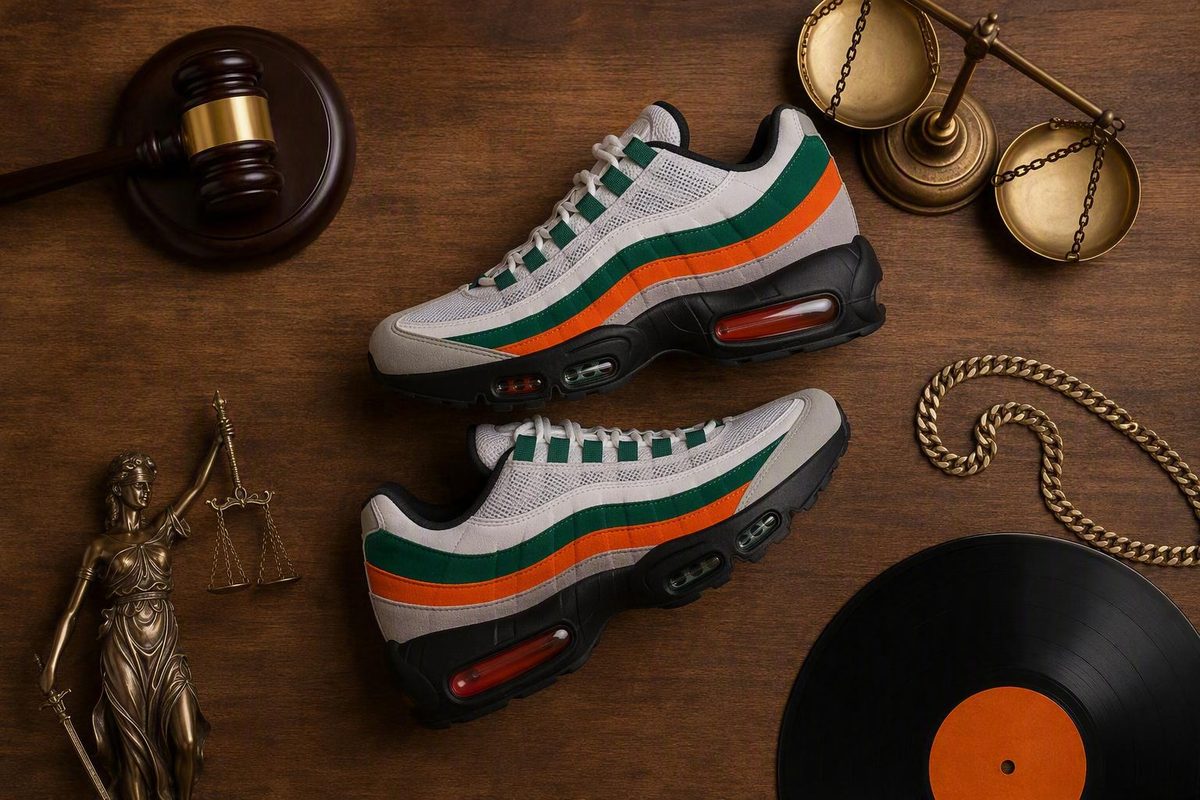
7-Eleven filed a federal trademark lawsuit against Nike over an unofficial Air Max 95 Big Bubble whose orange, green and red treatment—and planned July 11, 2026 launch—allegedly invoked the retailer’s branding. Reports then documented the shoe disappearing from SNKRS and some retailers withdrawing planned drops. But the reporting reviewed here, published in early July 2026, did not establish a court-ordered halt, a formal permanent cancellation by Nike, trademark infringement, a settlement or the final release outcome.
This is a filing-stage snapshot, not a statement of the case’s status after early July. Reuters identified the case as 7-Eleven Inc. v. Nike Inc., No. 3:26-cv-02201-X, filed July 1, 2026 in the U.S. District Court for the Northern District of Texas. Nike had not responded to Reuters by its July 2 publication deadline. Reuters reported the filing and linked to the federal complaint.
The short answer: what happened and what remains unconfirmed
| Question | Known or reported | Not established in early-July reporting |
|---|---|---|
| Was there a lawsuit? | Yes. 7-Eleven filed a federal complaint on July 1, 2026. | The allegations had not been decided. |
| What did 7-Eleven allege? | The shoe’s presentation could suggest sponsorship, endorsement or affiliation with 7-Eleven. | No court finding of infringement or likely consumer confusion was reported. |
| What happened to the release? | The pair disappeared from SNKRS, and some retailer drops were reportedly withdrawn. | The reports did not show that a court compelled those changes. |
| Was it canceled? | Release disruption was documented. | No formal Nike notice permanently canceling the shoe was documented. |
| Was the case resolved? | No resolution had been announced by July 7, 2026. | No ruling, settlement or final disposition appeared in the reviewed early-July reports. |
The legal and release questions need to be kept separate. Filing a complaint did not establish that Nike violated 7-Eleven’s rights. Likewise, a missing SNKRS entry or withdrawn raffle did not by itself establish a court order or permanent cancellation.
C-Store Dive reported that the case was filed in the Northern District of Texas, Dallas Division, and that Nike had not commented to the publication as of July 7. It also said no resolution had been announced by that date. That is the latest case-status point established by the reporting used here—not a claim about what happened afterward. C-Store Dive reported the status through July 7, 2026.
Which Air Max 95 was at the center of the dispute?
The disputed shoe was the Nike Air Max 95 Big Bubble commonly identified in coverage as the “Sport Green and Safety Orange” colorway. Its layered side panels incorporated orange, green and red, which 7-Eleven compared with its Tri-Color Mark.
The reported theory went beyond the colors. WWD described an insole graphic depicting convenience-store shelves and Nike product copy referring to “strolling down to the corner store” for a snack. Combined with the color blocking and July 11 launch date, 7-Eleven argued that those details implied an unauthorized association.
Contemporary reports also said the shoe was not an official Nike x 7-Eleven collaboration. Reuters reported 7-Eleven’s position that no partnership existed for the pair, while Sneaker News said Nike had never formally announced it as a 7-Eleven collaboration.
That distinction matters when reading release pages and resale listings. Sneaker outlets widely used “7-Eleven” Air Max 95 as an identifying nickname, but media shorthand does not prove that 7-Eleven approved, produced or endorsed the shoe. Nor does the apparent inspiration, standing alone, establish trademark infringement.
For collectors, the safest catalog description is therefore an Air Max 95 Big Bubble commonly nicknamed “7-Eleven,” but not documented as an authorized collaboration.
Why the July 11 release date mattered
The planned release date was July 11, 2026, conventionally written as 7/11. Reports said that date coincided with 7-Eleven Day and Free Slurpee Day at participating stores.
According to 7-Eleven’s account, the timing strengthened the association created by the orange, green and red panels, store-shelf imagery and corner-store product language. The retailer said the impending launch on its “birthday,” 7/11, required it to act quickly to protect its brand. Hypebeast reported 7-Eleven’s explanation of the timing.
That argument remained an allegation. The date did not, by itself, prove Nike’s intent or establish that consumers were likely to be confused. Those issues would require legal evaluation of the shoe’s overall presentation, 7-Eleven’s asserted rights and any defenses raised by Nike.
The date nevertheless explains why the filing and release reporting unfolded so quickly. The complaint arrived only ten days before the planned launch, leaving sneaker platforms and retailers to respond while the dispute was still at its earliest stage.
What 7-Eleven alleged—and what it asked the court to do
Reports described claims for federal trademark infringement and unfair competition, federal trademark dilution, and related causes of action under Texas law. In plain language, 7-Eleven alleged that the shoe could lead consumers to believe it was sponsored, endorsed, approved by or affiliated with the retailer even though no partnership existed.
The requested remedies were substantial. Reports said 7-Eleven sought to block distribution, marketing and sales; recall or destroy shoes and promotional materials; recover Nike’s profits and damages; and obtain attorneys’ fees and other monetary relief. The Fashion Law specifically reported requests for a permanent injunction, Nike’s profits, compensatory and enhanced damages, and attorneys’ fees. The Fashion Law summarized the pleaded claims and requested relief.
| Requested by 7-Eleven | Documented as granted in the reviewed early-July reports |
|---|---|
| Block distribution, marketing and sales | No |
| Recall or destroy shoes and promotional materials | No |
| Recover Nike’s profits and damages | No |
| Recover attorneys’ fees and other monetary relief | No |
The second column is deliberately dated to the reviewed reporting. It does not make a claim about later docket activity.
A requested injunction is not an issued injunction. The same rule applies to the complaint’s characterizations of Nike’s conduct as deliberate, willful, malicious or in bad faith: those were 7-Eleven’s allegations, not findings made by a judge.
Release timeline: filing, SNKRS removal, and the planned drop
The early sequence can be reconstructed from Reuters, Sneaker News and Sole Retriever:
- July 1, 2026: 7-Eleven filed its federal complaint in Dallas.
- July 2, 2026: Reuters and sneaker outlets reported the lawsuit.
- By 9:30 p.m. ET on July 2: Sneaker News reported that Nike had removed the pair from SNKRS.
- After the lawsuit became public: Sole Retriever reported that Kith withdrew its raffle and that other retailers canceled planned drops.
- July 11, 2026: The scheduled launch date shown in advance release coverage and cited in reports about the lawsuit.
Sole Retriever’s initial report identified the Sport Green and Safety Orange Air Max 95 Big Bubble, its planned July 11 release and the subsequent disappearance of its SNKRS listing. Sole Retriever documented the initial release details and SNKRS change.
The order of events makes an association between the lawsuit and the release changes plausible, but the sequence does not establish legal causation. The reviewed reports did not document a court-issued injunction directing Nike or retailers to stop the launch.
A retailer could respond to uncertainty voluntarily, and a platform listing can change without a judicial order. For that reason, the evidence supports a narrow conclusion: observed US release channels changed after the filing, while the ultimate distribution outcome was not established by the early-July coverage.
It would be equally unsafe to say that the July 11 release definitely occurred everywhere or definitively failed to occur in every market. The reports captured a release in flux.
Was the Nike Air Max 95 officially canceled?
The reviewed evidence supports saying the release was disrupted, not that Nike formally and permanently canceled it.
- SNKRS removal: Reported
- Retailer withdrawals: Reported
- Formal Nike cancellation notice: Not documented
- Court-ordered halt: Not documented
- Completed authorized retail launch: Not established
The qualified wording used by sneaker outlets reflects that uncertainty. JustFreshKicks called the pair “seemingly” canceled. Nice Kicks said it “may have been canceled,” while the body of its report still discussed possible availability through Atmos in Japan. Those formulations do not amount to confirmation from Nike.
A deleted product page, missing release-calendar entry or withdrawn raffle is meaningful release intelligence. It can show that an expected sales route changed. It cannot, without additional evidence, establish whether Nike postponed the shoe, limited it by region, privately abandoned it or responded to a legal command.
Resale listings require the same restraint. It does not establish an authorized retail launch, authenticity or provenance.
Collectors should therefore avoid turning “pairs exist” into “the retail release happened,” just as they should avoid turning “the SNKRS page vanished” into “a judge canceled the shoe.”
Collector reference: price, style code, and resale reports
Product reference
- Silhouette: Nike Air Max 95 Big Bubble
- Reported colorway: Sport Green and Safety Orange; some listings gave a longer color description
- Planned release date: July 11, 2026
- Common nickname: “7-Eleven” Air Max 95—unofficial, not a confirmed collaboration name
- Most commonly reported style code: IR1944-102
- Conflicting style code: IR1944-100 appeared in some coverage
- Reported retail price: $200 or $210, depending on the source
For cataloging purposes, IR1944-102 was the most commonly reported identifier. Nice Kicks used that code and listed the colorway as Sail/Metallic Silver/Total Orange/Sport Green/Gym Red/Light British Tan at $200. Other coverage used IR1944-100, however, so neither code should be presented here as a definitively verified first-party Nike identifier. Nice Kicks listed IR1944-102 and a $200 price while leaving the release status uncertain.
Price reporting also conflicted. Advance release pages listed $200, while Sole Retriever and several litigation-era reports used $210. The available reports do not resolve the discrepancy, so collectors should preserve the source attached to a code or price rather than converting repeated third-party data into an official specification.
The lawsuit also coincided with a reported change in resale pricing. Sole Retriever quoted StockX representative Brendan Dunne as saying that the pair averaged $161 through July 1, then $318 from July 2 through 8:30 a.m. ET on the interview date. Sole Retriever reported Dunne’s before-and-after StockX averages.
Those figures are a snapshot, not a universal market valuation. The report did not provide transaction counts, size-level results, full price distributions or independent auditing.
The three defensible takeaways are straightforward: 7-Eleven filed a trademark case over an unofficial Air Max 95 whose colors, product details and July 11 timing allegedly invoked its brand; the shoe was subsequently removed from observed release channels; and the reviewed early-July reporting established neither infringement nor an official permanent cancellation.
Any later update should be tied to case No. 3:26-cv-02201-X, a court filing, or a direct statement from Nike or 7-Eleven—not merely a resale listing, nickname or missing product page.